

While initially treated as a bit of a gimmick by many cricket fans, the Big Bash League has become a mainstay of the Australian sporting calendar, pulling big crowds and huge TV viewership night after night. We’ve witnessed plenty of spectacular moments so far this season and with finals looming right around the corner this is as good a time as any to ask: is it better to bat first or second?
The theory
The tactical element
From the perspective of the batsmen, knowing the target to be chased informs how a team bats: more aggressively with a larger total to reach and less so with a smaller one. Similarly, the fielding team can adjust their bowling and set the field in a way that suits the target they are tasked with defending. However, these tactical advantages are unlikely to be equally strong as generally speaking, batsmen have more room to change their style than bowlers and will benefit more from knowing the exact target. Imagine how differently players would bat in the following two scenarios:
1) With 3 overs left, the batting team needs 20 runs with 2 wickets in hand
2) With 3 overs left, the batting team needs 40 runs with 2 wickets in hand
While the bowler would change their approach to an extent and the field would look a bit different, the batting styles would almost certainly be a starker contrast. It seems reasonable that the chasing team has greater use for this information than the defending team does and that in this respect, batting second is the better option.
The psychological element
From a purely strategic standpoint, knowing all the variables provides you with an unquestionable edge, but between the ears it’s a different story. Revisiting the case of the batsmen, it’s not a stretch to say that being aware of the total you’re chasing adds an extra layer of mental pressure. Every dot ball represents the screws tightening as the required run rate slips ever higher. When you bat first, you know dot balls are bad, but when you’re chasing, you know exactly how bad they are, with agonising mathematical precision. In this respect, ignorance may well be bliss and teams may get some mileage from batting first and obliviously scoring as many runs as they can muster. For bowlers, knowing what you’re tasked with defending could carry a similar burden – a few bad balls smacked and it might be panic stations.
Intuitively, it feels like these nerves would impact batsmen more as bowlers can premeditate their delivery whereas batsmen are reactive, though it would be fascinating to hear the players’ experiences on the subject. If this is the case, batting first comes with a psychological advantage.
The conditions
The 20 overs format is distinct in that physical factors have a relatively small impact on the game. For instance, while pitch deterioration is a crucial influence on test match cricket, the brevity of T20 renders such a consideration almost irrelevant. The effect of weather would be the main influence in this category on a team’s decision to bat first or second. Note that this is the category that will change the most across matches; while the tactical and psychological effects are likely to remain somewhat stable over time, weather is unique with each match.
The evidence
For this section, all men’s BBL games since the league’s inception were used.
The first question that’s worth asking: when teams win the toss, what do they actually choose?
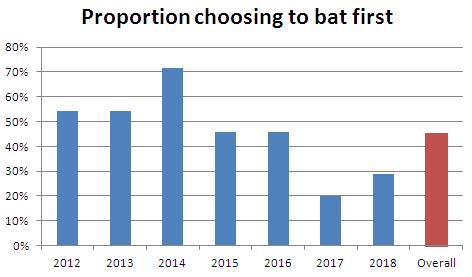
While batting first has dropped in popularity in recent years, teams still do it a decent chunk of the time. It’s interesting to note that a dominant strategy has not emerged; clearly teams must think that there are some cases in which it is optimal to bat first and some in which it’s best to bat second. This supports the idea that weather influences teams’ decision making.
So, is batting first or second superior?
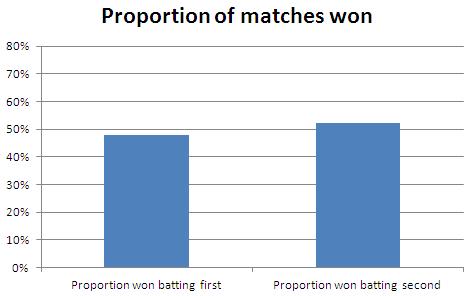
The striking thing about these results is that there’s little striking about them. Teams batting first have a 47.72% win rate while those batting second win 52.28% of the time. Second barely has its nose in front, and a quick statistical test shows the difference is hardly meaningful; if it were a 50% chance of winning either way, the odds of an outcome like this is pretty likely.
However, we must also consider the possibility that whether first or second is the better choice differs from match to match, and that teams can identify the correct option and perform significantly better than 50-50 after winning the toss. It could be, for instance, that batting first is optimal some of the time (because of factors like weather), but that because the majority of the time teams bat first it’s because they are forced to, this dampens the overall win percentage going first. To account for this, we have to look at the performance of teams that have won the toss and chosen to bat either first or second:
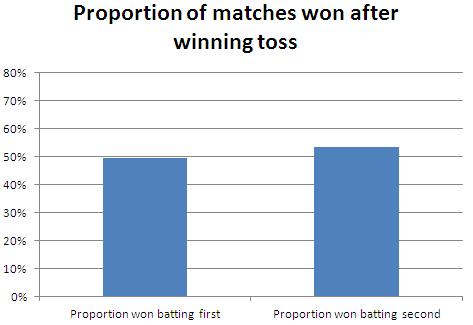
Alas, it still looks almost even. While teams do a bit better going either first or second when we only consider games in which they choose that option (bumping the win rates up to 49.55% and 53.54% respectively), the figures still aren’t significantly different (on a statistical level) from 50% to suggest that they’re gaining any real edge.
This suggests two main interpretations:
1) Whether you bat first or second is always a non-issue and is strategically irrelevant.
or
2) While first and second are approximately equally good choices in aggregate, on an individual match level one choice is better (due to factors such as weather, the psychological profile of the players in a team, etc.). However, teams can’t always identify whether it’s better to bat first or second in a particular match and sometimes will pick an option that is suboptimal (which would give them a worse than 50-50 shot at winning), which drags down the overall results.
The second possibility seems more plausible; what are the odds that all of the tactical, psychological and climatic considerations just happen to cancel out to 50-50 for every single match? That being said, it seems that even if teams got the decision right every time, they wouldn’t gain a huge edge.
Ultimately, it’s good for the game that batting first or second isn’t a big deal in practice and that something arbitrary like the coin toss has little influence. Whatever happens from here on out this season, you can be confident that the teams playing better cricket will be rewarded.
 The Beitzel Review